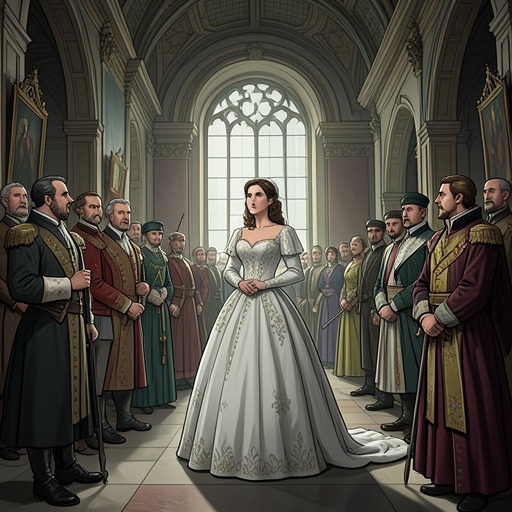
Margaret Tudor
The King's CurseMargaret Tudor is Henry VIII’s sister and the queen consort, then dowager queen, of Scotland. Her story joins dynastic diplomacy to the instability of private life: the death of her first husband leaves her a widow with a young child, while her remarriage costs her the regency and custody of her sons. Later, her effort to end a second marriage makes her a test case in arguments about a marriage bond that Henry VIII himself insists cannot be broken.
A queen between two kingdoms
In the summer of 1513, Henry VIII’s campaign in France left England exposed when the Scottish king invaded, despite the peace secured through his marriage to Margaret. With the English king overseas, Katherine of Aragon and Thomas Howard organized the kingdom’s defense. Their preparations culminated in victory over the Scots and the death of Margaret’s husband. Thomas Howard sent Katherine the dead king’s bloodstained coat; Katherine passed the signs of victory to Henry VIII in France. The outcome was a personal catastrophe for Margaret as well as a major political reversal: she was widowed and left with a seventeen-month-old child.
The consequences reached beyond Margaret’s household. Scotland had lost its king, Margaret had become a dowager queen, and her brother’s government had to reckon with the future of the Scottish crown. In the following year, English concern focused on the possibility that Scotland’s new regent, the Duke of Albany, might align with France. Henry VIII responded by arranging Princess Mary Tudor’s marriage to the French king, hoping to secure England’s position before the Scots could make that alliance. The match was therefore bound up with Margaret’s situation, though it was Princess Mary Tudor who had to bear its immediate personal cost: she opposed the marriage and asked Katherine of Aragon to help her persuade Henry VIII to let her marry for love.
Remarriage and the loss of power
Three months before Katherine of Aragon was expected to give birth in autumn 1514, news arrived that Margaret had married Archibald Douglas, Earl of Angus. The marriage changed her political standing at once. She lost her right to act as regent and the care of her two-year-old son and his six-month-old brother. Margaret and her new husband withdrew with the children to Stirling Castle, while John Stewart, Duke of Albany, took power as regent.
The retreat did not give Margaret lasting security. By autumn 1515 she had escaped Scotland and reached a northern castle, where she gave birth to a daughter, Margaret Douglas. The account presents her as isolated: her husband had returned to Scotland, while she was in exile and had to make her way south to safety with her brother. Katherine of Aragon sent what Margaret needed for the journey. That practical assistance connects Margaret’s family crisis to the support network of the English court, even as the larger political arrangements had helped place her in a vulnerable position.
Margaret’s remarriage thus produced a sharp reversal. Marriage had not simply altered her private life; it had changed who could govern Scotland and who controlled the upbringing of its young heirs. Her flight and exile then separated her from the country in which she had been queen. The narrative does not resolve her later political position, but it repeatedly returns to the costs of a marriage that she had chosen for love and that had become a source of conflict.
A marriage disputed
Later reports describe Margaret seeking to end her marriage to Archibald Douglas. A northern lord warned Thomas Wolsey that she was asking the Duke of Albany for help in obtaining a divorce, and predicted bloodshed rather than a peaceful annulment. The report is a warning from a political observer, not an account of a completed divorce. Another episode presents Margaret as turning her castle’s cannons against her husband while trying to persuade the Pope to grant an annulment. Together, these reports make the marriage a public struggle over her choices, not merely a private disagreement.
Henry VIII intervened by writing to Margaret and her unwanted husband. He invoked the sanctity and permanence of marriage, maintaining that no man could separate what had been joined. His position is especially striking beside the later crisis over his own marriage to Katherine of Aragon: the principle he asserted to his sister would become a central issue in his own contest with the Church. Margaret’s case also carried political risk. A proposed divorce could unsettle relationships among Scottish leaders and raise the prospect of violence, while the king’s appeal to religious doctrine made her personal decision subject to royal scrutiny.
The dispute also enters the education of the next generation. Princess Mary Tudor cites her aunt Margaret’s conflict as a counterexample when discussing whether a woman should marry for love. Margaret’s experience complicates the simple idea that a love match guarantees happiness: she had chosen her husband for love, but later sought a way out of the marriage. Henry VIII, meanwhile, had told Margaret that marriage could end only with death. The episode places competing ideas of marital choice and obligation side by side without resolving them.
Family, diplomacy, and the limits of authority
Margaret’s story is framed by overlapping family ties and political calculations. She is Henry VIII’s sister, a queen across the border, and the mother of children whose custody and succession matter to Scottish government. Her widowhood changes the balance of power; her second marriage removes her from the regency; and her exile requires help from Katherine of Aragon. Each shift shows how a woman’s marital status could determine not only her household but also her public authority and access to her children.
The treatment of Margaret’s divorce request further reveals that authority is contested among the Crown, the Church, and individual judgment. The Pope is asked to grant an annulment, while Henry VIII insists that marriage is indissoluble. His intervention turns a family dispute into a question of who may decide whether a marriage can end. In later events, Henry VIII’s break with papal authority and his claim to rule the Church himself transform that question on a national scale. Margaret’s earlier predicament therefore anticipates, on a smaller and more personal plane, the broader conflict over marriage, religious jurisdiction, and royal power.
Margaret does not appear in these episodes as a settled victor or a figure whose eventual circumstances are fully reported. What the narrative establishes is a recurring pattern of reversal: queen, widow, regent, displaced mother, exile, and wife seeking release from a marriage her brother declares permanent. Her importance lies in how those roles connect family life to statecraft, and in the contrast between her effort to make a consequential choice and the competing authorities that claim the right to define what that choice may mean.